Showing posts with label Implant Dentist. Show all posts

Wednesday, June 1, 2016

Options Available from an Implant Dentist

Implant Dentist
For an implant dentist, it is easy to understand how dental implants have made such a huge impact on all different forms and techniques of replacing teeth. In the modern world of dentistry, we use dental implants to support a variety of other techniques, including dentures. Dental implants have literally changed the way we look at replacing teeth, vastly improving the stability and security of devices like dentures and dental crowns.

Dentures Have Limitations 

Dentures have been around for a very long time; however, they have severe limitations. Dentures are placed on top of the gums, where the fake teeth have to be secured with the help of wires or messy adhesives. As a result, unsecured dentures tend to fall out very easily or don't feel secure when you are chewing harder substances. All these limitations have been addressed by the invention of implant-supported dentures.

Dental Implants Behave Like Natural Teeth

As your implant dentist, we will tell you that dental implants are so effective because they mimic, virtually perfectly, the natural order that teeth are supposed to exist in your mouth. The dentures, or the dental crowns, act as your teeth that you see above the gum line. The dental implant acts as the root securing the tooth to the jawbone and also providing the jawbone with necessary stimulation.

Implant-Supported Dentures

There are two distinct types of dentures that typically use dental implants. The first is a ball-retained denture, also known as a stud-attachment denture, where each of the implants placed by your implant dentist has a metal attachment that fits into another attachment on the denture itself. Attachments on the implants are typically ball-shaped, known as male attachments, and they fit into sockets, known as female attachments, on the denture itself. The second kind of dentures that can be placed with the help of dental implants are bar-retained dentures. In the case of bar-retained dentures, a thin metal bar, designed to follow the curve of your jaw, will be attached to between two and five dental implants that have been pre-planted by your implant dentist into your jawbone. The bar is attached to the denture with a series of clips. The denture fits snugly over the bar for additional stability, while also hiding the bar for better aesthetics.
Regardless of the type of dental implant-supported dentures you will be getting, the one thing you can rest easy knowing is that the dentures fitted on the implants placed by your implant dentist will be far more secure than traditional dentures. With the help of your implant dentist, you will have the ability to smile easily, chew on any food you want, and have the safety and security of having teeth that are fully attached, just as nature intended them to be.

Traditional Dental Implants

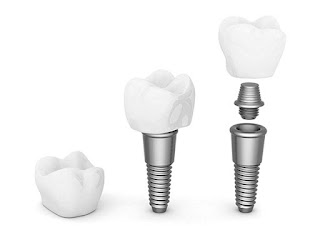
As an implant dentist, we can also replace your teeth on an individual basis by implanting a small titanium post under your gums in each position where your missing teeth once were.  Once the process of osseointegration has taken place, we will secure a new tooth to the abutment attached to your implant.  This completes the process and is the most natural and durable way to replace missing teeth because we will have effectively replaced your roots and teeth.
To learn more about your options, call our office and schedule an appointment with an implant dentist.

Thursday, October 1, 2015

An Implant Dentist Explains How Dental Implants Work

Implant DentistIf you are interested in receiving dental implants to replace missing teeth, an implant dentist in our office can help you better understand the procedure that will take place to make this happen. Receiving dental implants is an exciting time and will provide you with attractive, hard-working teeth for years to come, but you should also be prepared to undergo the necessary procedure. We can help you learn what to expect during this process.

Consultation with an Implant Dentist

Before your procedure is solidified, you will need to meet with an implant dentist in our office so we can ensure dental implants are the right tooth replacement option for you. There are many factors we will consider such as general bone and soft tissue health, whether or not you have recently had periodontal disease (gum disease), and if your remaining jawbone is strong enough to support the implant. If you have a healthy mouth, you will most likely qualify for dental implants.

Dental implants are different from dentures and dental bridges, but they can be used as a base structure for dentures and bridges when necessary. Dental implants are typically stronger, longer-lasting, and more realistic in appearance than other tooth replacement choices. In some cases, they are also more costly, but the price is affordable when you consider an implant is as strong or stronger than your natural teeth, and the implant post itself should never need to be replaced.

How Dental Implants are Placed by an Implant Dentist

A dental implant is a post made up of titanium, a metal that is biocompatible and will eventually fuse with your jawbone. The post is basically a tooth root replacement, and it is surgically implanted into your jawbone. After implantation, it will take a few weeks to months for the implant post to osseointegrate with your bone. Once the fusion is complete, it will form the strongest replacement option for a missing tooth. Once the implant is stable, an abutment will be placed on the long-lasting implant. An artificial tooth will be screwed onto or bonded to this abutment. The artificial replacement tooth can be an individual prosthetic in the form of a custom-created crown top, a dental bridge, or even partial dentures. One implant can support a larger structure, making it an optimal option for one who is missing several teeth.

After Dental Implant Placement

Once an implant dentist finishes placing your dental implants, you will get to use your implants just like natural teeth. They should also be cared for like you would care for your real teeth. The stable implants allow you to chew the foods you couldn't while missing teeth, and they give you the ability to smile with confidence again. Dental implants will also prevent your face from looking sunken in and older because implants help maintain the natural, firm shape of your face.

To learn more about how dental implants are placed and how they can benefit your life, visit our office to speak with an implant dentist about receiving your very own dental implants.

  >  

Thursday, January 1, 2015

An Implant Dentist Reviews What the Recovery Process is Like After Surgery

Implant Dentist
As an implant dentist, we replace damaged or missing teeth on a regular basis.  For many of our patients, dental implant surgery doesn't seem like a very big deal. When you consider the speed of recovery and the amount of impact it has after the surgery, there is definitely a case to be made for it being a very low impact surgery. That being said it is important to remember that minor thought it may be, dental implant installations are, in fact, a surgical process. As a patient, you need to remember this and schedule the procedure for when you will be able to do nothing but recover for several days. Avoiding strenuous situations, like lifting heavy objects, for example, is strongly encouraged. The last thing we want is to have you back for a repair surgery or to fix ripped sutures. 

Time heals dental implant most effectively. Within the first day, you will experience a great deal of recovery, and should be able to go back to life as usual the following day. Naturally, we recommend staying away from anything overly strenuous for at least 4 to 5 days. The overall recovery from dental implant surgery will take several days, and will involve your active participation to be a success. What you do and the choices that you make will play a critical role in determining how quickly you heal from the surgery. To help you along, we will give you with information and instructions on how to best recover.  Following these tips can save you the heartache of a long recovery cycle. 

When you leave you will have a prescription for an antibiotic. It is important that you fill this prescription and take the entire course. As with any surgical procedure the greatest risk to a dental implant surgery is an infection. Taking the antibiotic is a precautionary measure that could prevent an infection from occurring. Since antibiotics can be harsh on the stomach, we advise our patients to take the pill with meals or to use a glass of milk. Milk helps to line the stomach and offset the irritation caused by the antibiotic. In addition to the antibiotic, you will also have a medicated oral rinse to use. Combining this rinse with salt water rinses will work to keep the site of the dental implant surgery clean and disinfected. As an implant dentist, this is the only way we advise washing out the area, since you will not be able to brush it for several days because of the stitches and soreness. 

Bleeding is perfectly natural and occurs in every case of dental implants being installed. You will notice some blood in your saliva. As an implant dentist, we will give you gauze pads to control the bleeding. Using these gauze pads to put a little pressure on the tooth will help to stop the bleeding and also help with clotting. When holding the gauze in place, use light pressure as too much pressure could result in severe discomfort. If you are having discomfort, as many patients do, after the anesthesia wears off, you can always remedy this with over the counter pain medication like Advil or Tylenol. You can also use a cold compress to help reduce or prevent swelling.  Within a couple of days you should feel as good as new, so these are only temporary measures. 

Tuesday, November 4, 2014

Learn More Facts About Replacing Teeth From an Implant Dentist

Implant Dentist
As an implant dentist, we know that more than 3 million Americans have dental implants today. Dentists have been successfully performing implant dentistry for the better part of fifty years, though only now has the popularity of this procedure really started to grow. Seen for many years as a cosmetic fix, oral health professionals are now advising dental implants for a host of tooth loss problems. Teeth can be lost very easily after an accident, playing sports, due to normal aging, or disease. Having a way to replace teeth and give a person back their speech patterns, their smile, and their natural look is an extremely powerful tool; one that we use on a regular basis. 
What is a dental implant?
A dental implant is a small titanium screw which is placed into the jawbone of a person’s mouth. An abutment is added, which is a piece that sticks out from the gum and connects the implant to the crown. Finally, a crown or a uniquely sculptured replacement tooth is placed over the abutment to finish the effect. When completed a dental implant looks and feels exactly like real teeth, giving the patient the comfort and familiarity they are used to with their naturally occurring teeth. 
How much does a dental implant cost?
Dental implants have been slowly going down in price. However, they are still costly to get and often can be cost prohibitive to those who need a replacement tooth.   A single tooth implant can cost between $1,500 and $3,000 with an additional cost of $500 to $3,000 for the crown. Many factors come into play when pricing out an implant, including the amount of support work that will need to be done, the number of teeth to be replaced, extractions, and other treatment that might become necessary around the implant. Also, one has to factor in the type of implant and the materials to be used. As an implant dentist, we can give you a precise quote after a consultation.
What is the process of getting a dental implant?
The process of getting an implant can take up to six months when you consider healing time. To start the process, we will discuss all the options available to you. Next, you will be scheduled for a comprehensive examination and consultation. Once you decide to proceed with the implant, we will take an imprint of the tooth to be replaced along with the gums and nearby teeth. This allows the crown to be customized to fit your mouth perfectly. 
On the day of the surgery, we will implant a small screw or post into your jawbone. It is placed into the socket of the missing tooth and allowed to heal. Healing takes between six to twelve weeks. On your return a small connector post, known as an abutment, will be attached to the implant. The abutment sticks out above the gum line and connects, on the other end, to the crown. An additional two to three weeks of healing are required after the abutment is placed. Finally, the dentist will install your crown or replacement tooth to the abutment. Following some checks and tweaks to ensure your bite is perfect, you will have a perfect new replacement tooth.